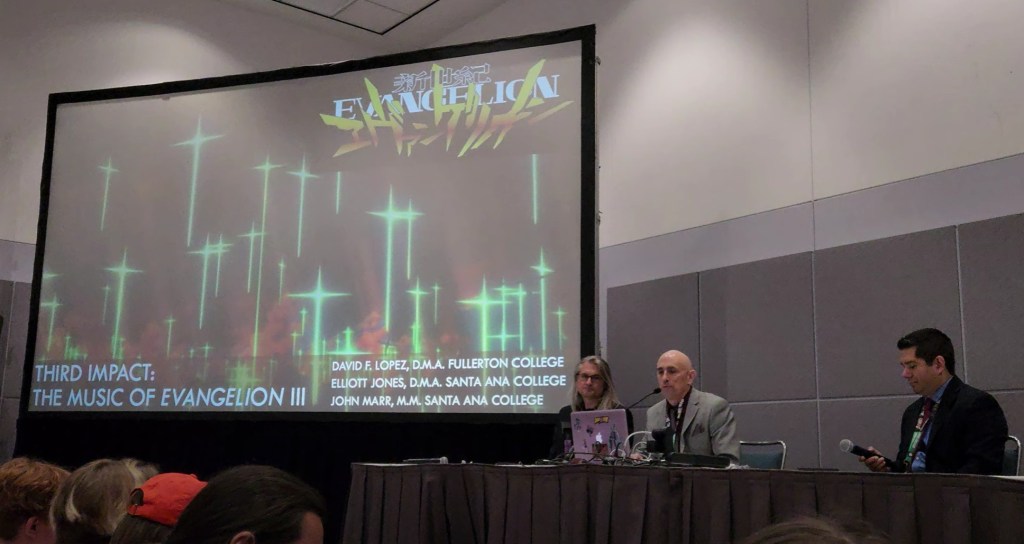
Professors John Marr, David Lopez, and Elliott Jones were back at Anime Expo with another highly insightful lecture on the music of Evangelion. Third Impact: The Music of Evangelion is part of the academic lecture series at Anime Expo. In 2022 and 2023, they held the first and second parts of this music analysis panel on Evangelion’s music, to which over 700 attendees attempted to attend. Just as popular as in previous years–despite the fact that we’re all attending class at an anime convention by choice lol–this panel once again drew hundreds of eager attendees, filling every seat. Unfortunately, just like last year, the room reached capacity, and not everyone who hoped to join was able to get in.
Professor Marr launched the lecture off with Shiro Sagisu, taking a look at “Paris” from Evangelion 3.0+1.0, the song that ended up unpresented last year due to time constraints. He proceeded to touch upon various musical factors that contribute to the song’s composition and use in the film, including the progressive rock influence and pointing out the virtuosic playing, 7/4 time signature, and heavy syncopation, instrumentation, and more.
Next, Professor Lopez introduces “The Sorrow of Losing the Object of One’s Dependence” from Neon Genesis Evangelion III. This particular version is rhythmically free, no harmony, and differing pitches, though it will still sound recognizable as “Fly Me to the Moon.” The jazz ornamentations present are intended to make the piano sound more soulful.
Professor Jones continues with “Yearning for Your Love” from Evangelion 3.0+1.0. He mentions that there is a strong Beatles influence for this song, pointing out that the chord progression evokes a sense of “Dear Prudence,” or the opening trumpet lines feeling reminiscent of “Penny Lane” and “All You Need is Love.” In addition, he also mentions the use of vocal harmonies on secondary dominant seventh chords as another similarity.
After, Professor Marr discusses “Furimukanai de” from Evangelion 2.22 You Can(Not) Advance. Interestingly this song is considered to be one of the first Japanese pop tunes. This song in particular uses a I-vi-IV-V progression, which was very common at the time.
Professor Lopez then analyzes “Voyager/Undated Grave Markers (suppa duppa bossa) from Evangelion 3.0+1.0. This version of the song is a bossa nova version, with bass moves on beats 1 and 3 and guitar comps. The bossa feel makes the familiar song feel more fresh. The song also adds strings for variety in the arrangement.
Next, Professor Jones talks about “Jesus Bleibet Meine Freude” from End of Evangelion. As a choir professor, he originally picked this song because the original song was a Bach cantata. In addition, the original arrangement created by Bach was already a compiled piece, where Bach incorporated both lyrics and music from different pieces from other contemporaries. However, the current version used for Evangelion steps even further and uses the 1926 version from English pianist Myra Hess, who further rearranged Bach’s version and then the Evangelion version also further rearranged the song. The resulting piece sounds different but still recognizable when played.
One of the highlights of these lectures is when the professors play through each of the songs and point out specific elements they discussed, ensuring easy understanding for the audience and ‘students.’
For those that missed the panel, you can watch below for the full lecture:
Join the fun next time as the group plans to return with more music analyses next year.
 AniMuseCollection
Leave a comment