Much like previous years, the auditorium was jam-packed with fans eager to listen to the newest lecture on anime music, presented by Professors John Marr, David Lopez, and Elliott Jones. The speakers previously covered the music of Evangelion in depth in a three-part series (First Impact, Second Impact, Third Impact), and ventured into the world of Makoto Shinkai and RADWIMPS last year. This year, they spoke on the music of Studio Ghibli and Joe Hisaishi.
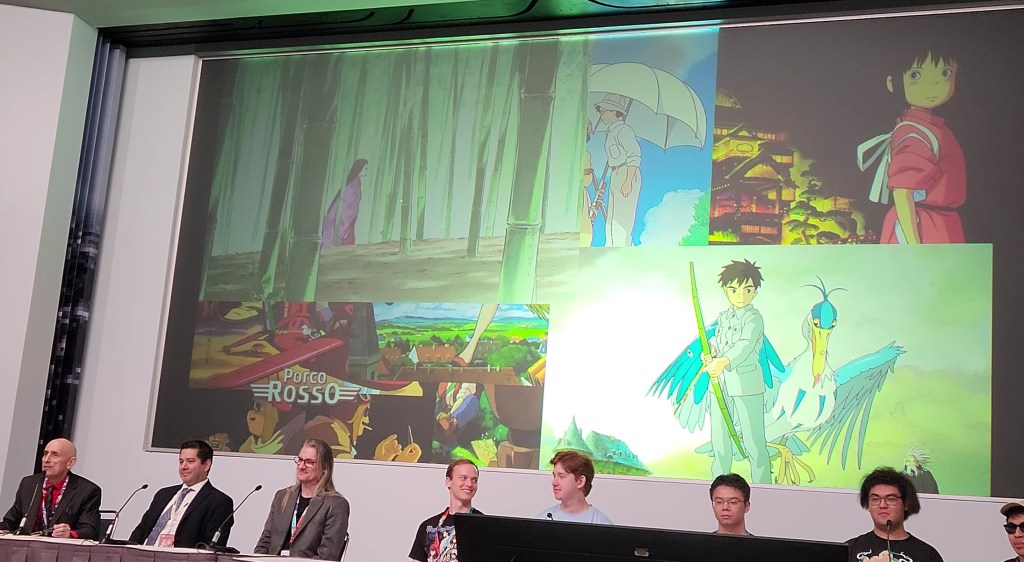
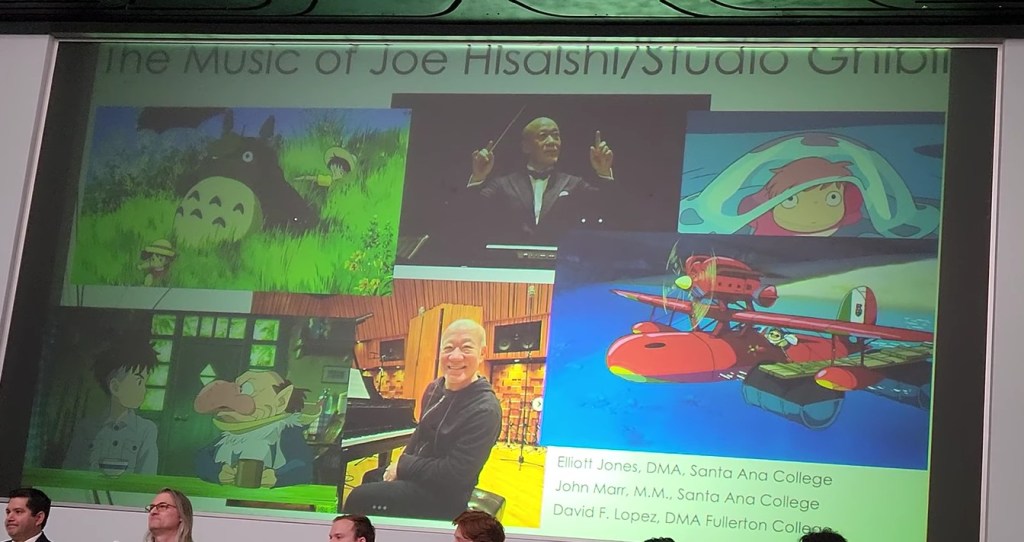
Professor Marr launched the panel with a detailed background of Joe Hisaishi, one of Japan’s most famous composers and is best known for creating music for many Studio Ghibli films. He has worked closely with directors Hayao Miyazaki and Isao Takahata for decades, composing memorable soundtracks for films such as My Neighbor Totoro, Princess Mononoke, Spirited Away, and Howl’s Moving Castle. His music combines classical, minimalist, and jazz styles, making him one of the most respected composers in anime and film. His work has earned worldwide recognition, including being named Composer-in-Residence with the Royal Philharmonic Orchestra from 2024 to 2027.
Marr then shifted to a music theory discussion, explaining key elements of traditional Japanese music. The discussion covered the origins of Japanese musical modes, including the In and Yo pentatonic scales, as well as concepts such as short musical motifs, four-beat meter, and the idea of Ma, the meaningful use of space and silence in music.
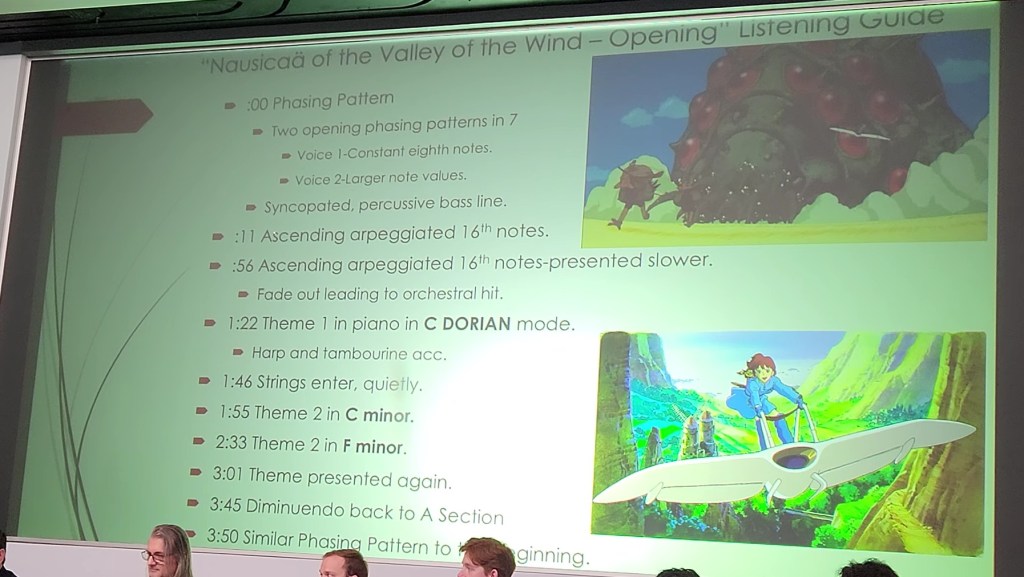
The first song analysis of the day was the opening theme of Nausicaa of the Valley of the Wind. The panel examined the song, highlighting how Joe Hisaishi blends electronic and orchestral music in a clear three-part structure. The opening and closing sections feature minimalist-inspired synthesizer passages influenced by composer Terry Riley, using layered melodies that move in and out of sync to create a sense of motion. In contrast, the middle section shifts to a warm orchestral style inspired by Russian composer Sergey Rachmaninoff, with sweeping melodies, rich piano textures, and expressive rhythms that would become hallmarks of Hisaishi’s later Studio Ghibli scores. The speakers also noted that the early use of synthesizers, including the Yamaha YC45 combo organ, was partly a practical choice at a time when recording with a full orchestra was often too expensive.
Next, Professor David Lopez introduced “Village in May” from My Neighbor Totoro, speaking on how jazz influences are seen in Hisaishi’s music. He explained that although the piece is not written as jazz, its simple melody, rich orchestration, and triplet rhythms make it well suited for jazz interpretation. Professor Lopez highlighted how performers can transform the piece by adding jazz harmonies, syncopation, and melodic ornamentation—techniques often associated with composers such as George Gershwin. According to Lopez, these elements reveal the flexibility of Hisaishi’s compositions and their ability to cross between classical and jazz styles.
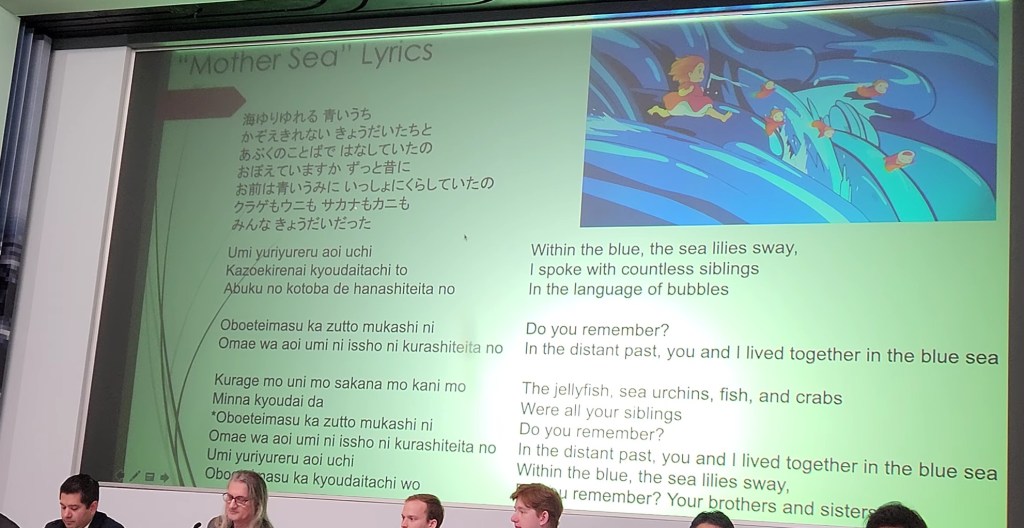
Professor Elliot Jones next touched on “Mother Sea” from Ponyo, highlighting its operatic style and classical influences. He explained that the piece draws inspiration from works such as The Little Mermaid, Dvořák’s Rusalka, and Wagner’s Ring Cycle, while its flowing waltz rhythm and recurring melodies gradually build emotional intensity. Jones also emphasized the use of classical vocal techniques, noting that the singer’s warm, legato performance enhances the nurturing and emotional qualities at the heart of the film.
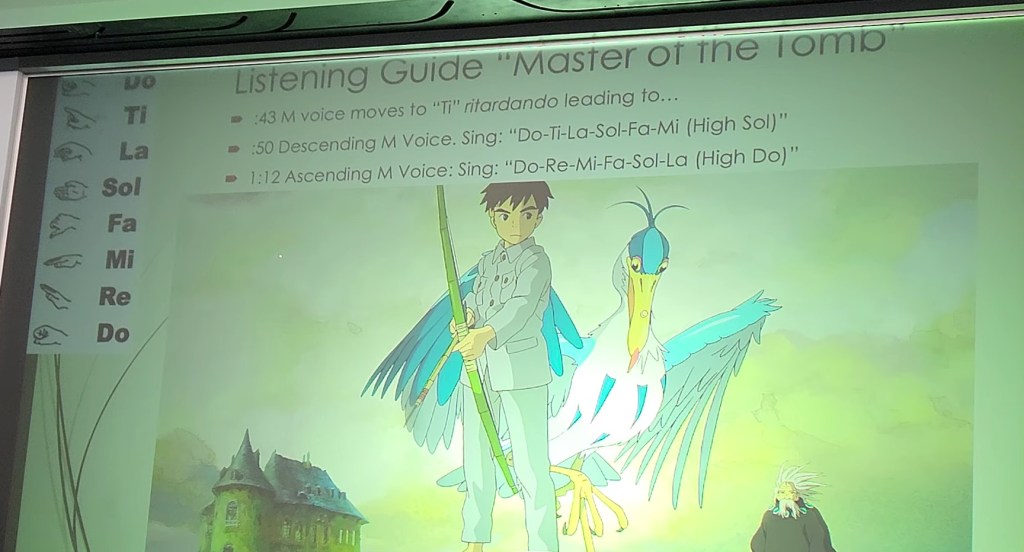
Professor Marr chose the most recent film, The Boy and the Heron, for his next analysis, focusing on “Sanctuary” and “Master of the Tomb.” The two songs have strong influences from Estonian composer Arvo Pärt’s minimalist style. He explained how Hisaishi uses Pärt’s tintinnabulation technique to layer melodic and harmonic lines, creating a sense of balance between human emotion and a steady, almost spiritual presence. He also noted Hisaishi’s deliberate use of unresolved harmonies at the film’s conclusion, leaving the audience with a feeling of openness rather than closure. This reflects Hisaishi’s ability to draw inspiration from other composers while shaping a musical style that remains uniquely his own.
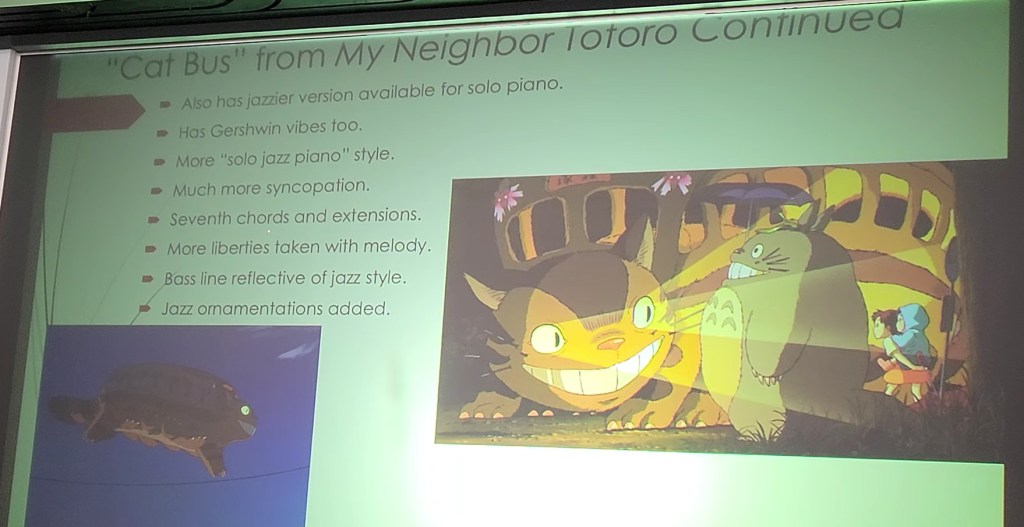
Professor David Lopez then continued his exploration of My Neighbor Totoro by examining “Cat Bus,” highlighting its strong jazz influences. He noted that a solo piano arrangement of the piece further emphasizes its Gershwin-inspired style through increased syncopation, jazz-style bass lines, extended seventh chords, and expressive ornamentation. According to Lopez, these elements demonstrate how Hisaishi’s compositions can naturally be reinterpreted through a jazz lens while retaining their original charm.
Closing out the lecture, Professor Elliot Jones analyzed “Path of the Wind” from My Neighbor Totoro, focusing on how Joe Hisaishi creates memorable melodies through classical composition techniques. He explained that the piece follows a traditional 8-measure structure, with a “question-and-answer” phrasing that builds tension and then resolves it clearly, making the music both accessible and emotionally satisfying. Jones also noted that Hisaishi’s themes are designed to evolve through different arrangements, allowing them to remain recognizable across orchestral and solo performances. He pointed to several recordings as examples of how the piece can be reinterpreted while preserving its core melodic identity.
Overall, the discussion highlighted Hisaishi as a composer whose versatility continues to shape the sound of Studio Ghibli and modern anime music. While attendees may not expect a lecture-style session at an anime convention, many stayed well beyond the scheduled hour to take part in the lively Q&A and enthusiastically engage with the discussion. With another successful panel wrapped, the strong turnout and excitement in the room make it clear that fans are eager for even more deep-dive music analysis year after year.
Make sure you catch them next year at Anime Expo 2026!
View the full lecture & Q&A below if you missed this session:
 AniMuseCollection
Leave a comment